

Comparing casino markets is like judging a Nascar race against Formula 1. Both have fast cars and skilled drivers. But the tracks, rules, and strategies are vastly different.
We dive deep into what makes each market special. It’s not just about the numbers.
We consider things like regulations, who visits, and local culture. A high roller in Macao is different from a convention attendee in Singapore.
We make sure everything is on the same level. This includes hold percentages and how much money comes in. This way, we can really compare them.
Without context, it’s like comparing durians to watermelons. They’re both fruits, but they don’t mix well at dinner.
IR Model Comparison (scale, margins, visitation)
Let’s dive into the battle of Asian gaming giants – Macao versus Singapore. The numbers show a clear story of two different paths to success in integrated resorts.
Singapore’s Marina Bay Sands had a 51.7% EBITDA margin last quarter. That’s tech company numbers. Macao’s properties are around 35%. The big difference is Singapore’s focus versus Macao’s big volume.
Singapore made $1.44 billion in Q3 2025 with just two resorts. Macao made $1.90 billion with six. Singapore’s secret is fewer tables but higher earnings.
The Venetian Macao has 28,000 employees. That’s like a small city. Singapore attracts specific groups like convention attendees and luxury shoppers.
Macao relies a lot on VIP players, even with new plans. Singapore sees gaming as a bonus to their other businesses.
The margin difference shows a key point about table productivity. Singapore gets the most out of every space and table. They focus on quality, and it’s paying off.
Looking at market share, Singapore’s two IRs have a strong position. Macao’s six have to fight for attention. Both make similar money but in different ways.
When we look at table productivity, Singapore’s strategy shines. They show that sometimes, less is more. This is when less means high efficiency and top spots.
Table Productivity & Minimums
If casino tables could talk, Singapore’s would be boasting about their productivity numbers like a Silicon Valley unicorn. The city-state has perfected the art of extracting maximum value from every gaming position. It turns what was once a volume game into a precision operation.
Marina Bay Sands’ Q3 2025 numbers tell the story better than any analyst could: $905 million in mass gaming and slot win represents a 35% year-over-year increase. This isn’t just growth – it’s a masterclass in operational efficiency.
While Macao’s recent market share increase to 25.4% in the mass segment shows they’re catching up. The difference? Singapore treats customer reinvestment as strategic investment, while Macao historically viewed it as expense.
The minimum bet story reveals even more about these contrasting philosophies. Singapore’s higher thresholds act as an economic velvet rope, pre-selecting for premium play. This maximizes per-table yields. Macao’s broader range accommodates more players but potentially dilutes that precious table productivity metric.
It’s the difference between a Michelin-star restaurant and an all-you-can-eat buffet – both can be profitable, but the business models couldn’t be more different. Singapore’s approach proves that sometimes, less really is more when you’re playing the high-stakes game of casino economics.
Non‑Gaming Yields: rooms, retail, MICE, entertainment
The real money isn’t in the slot machines. It’s in the high-margin yields from retail, rooms, and conventions. Gaming revenue gets all the attention, but the real profit engine works quietly in Singapore’s resorts.
Marina Bay Sands is a prime example of diversified revenue. It’s not just a casino. It’s a luxury retail spot, a convention center, and an entertainment complex. Its $1.44 billion Q3 2025 revenue shows how much it makes from non-gaming activities.
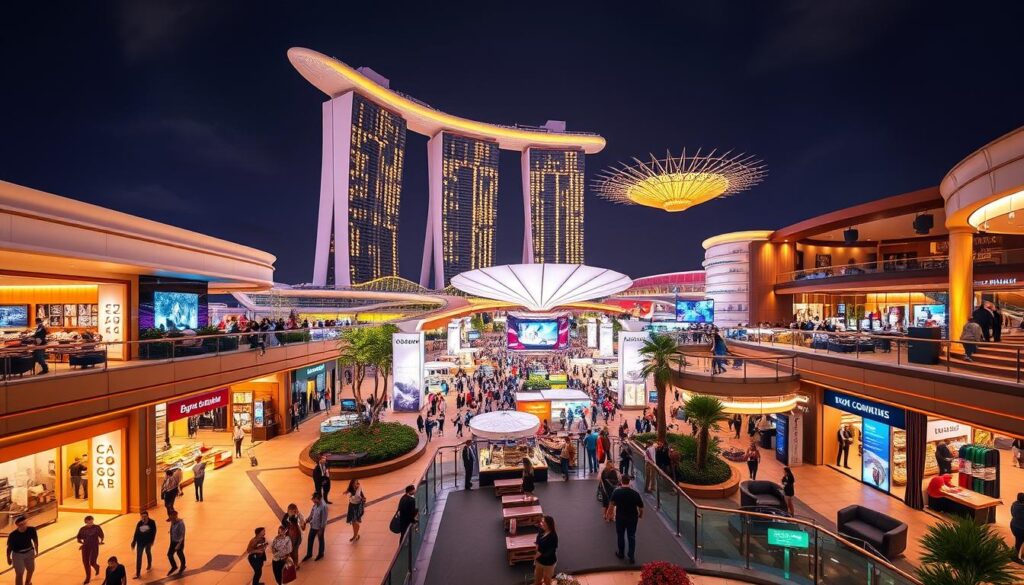
- Retail Renaissance: It has over 300 luxury outlets. These aren’t just any shops. They’re high-end brands that attract visitors from all over.
- MICE Magnificence: Its convention facilities can handle 45,000 delegates at once. That’s a lot of people, and the money they spend is huge.
- Room Revenue: The luxury rooms charge high prices all year. This gives the resort stable income, no matter what happens with gaming.
- Entertainment Empire: The resort has theaters, museums, and attractions. These draw visitors who might not even go to the casino.
Marina Bay Sands is not just about making money. It’s also about saving energy. It has saved 11% of energy with quick payback times. It also uses LED lights and smart systems to save even more.
This isn’t just about saving money. It’s also about being green. The savings help the bottom line and appeal to today’s consumers and investors.
The retail part of Marina Bay Sands is special. With over 300 outlets, it’s a major draw. It makes a lot of money, more than the casino, without the regulatory issues.
The MICE facilities at Marina Bay Sands are also key. Hosting 45,000 delegates is big business. It’s not just about room rentals. It’s about corporate spending at high rates with long-term contracts.
The entertainment options at Marina Bay Sands add to its appeal. They give visitors more reasons to come, not just to gamble. This mix of activities makes the resort financially stable, something pure-play casinos can’t match.
Choosing to diversify revenue is smart. It’s not just about luck. It’s about strategic planning and doing things right. Marina Bay Sands has set a good example for other resorts to follow.
Regulatory Landscape & Entry Levy
Let’s explore the velvet rope of casino economics – the rules that set high-rollers apart from casual gamblers. Las Vegas welcomes everyone, but Asia’s resorts have different rules.
Singapore’s entry levy system is a top example of smart rules. It’s like a financial bouncer at the door. You pay S$100 for a day or S$2,000 for a year. This makes locals think twice but welcomes international players.
Now, compare this to Macao’s open policy or Korea’s unique rule for locals. The rules in Asia vary a lot. They affect how much money casinos make and how they impact society.
So, why does Singapore’s system work? Here are three reasons:
- It keeps vulnerable people safe while bringing in tourist money
- The tiered prices make people think twice without keeping them out
- The money from the levy helps fund social programs, a win-win
Studies show casinos can harm society without the right rules. Singapore shows it’s possible to make money and help society at the same time.
The entry levy is more than a tax. It’s a smart way to guide behavior. Other places should learn from it. For more on rules, see this regulatory comparison guide.
When planning resorts, remember: good rules balance money and social care. Singapore’s way is a lesson in getting it right.
Infrastructure & Air Connectivity
Real estate’s golden rule is location, location, location. But for integrated resorts, it’s even more important. Singapore’s geographical advantage isn’t just good fortune; it’s strategic genius. This makes Marina Bay Sands the top choice for gaming destinations worldwide.
Changi Airport is more than just an airport. It’s ranked among the world’s best. It brings high-value visitors right to Marina Bay Sands, making the journey from the airport to the casino seamless.
The area around Marina Bay Sands is a model of urban planning. It has integrated transportation, walkable amenities, and easy connections. All these elements work together perfectly.
Other gaming hubs face problems like overcrowding and poor transportation. But Singapore’s investments focus on creating great experiences, not just moving people.
Strategic location in Southeast Asia creates a natural catchment area of affluent travelers. Singapore’s business-friendly environment makes it the go-to place for conventions and meetings.
This isn’t just about infrastructure. It’s a competitive edge that Marina Bay Sands uses to its advantage. The smooth connection from airport to hotel to casino floor shows operational excellence.
When your airport feels like a luxury mall and your transportation is as reliable as a Swiss watch, you’re not just building infrastructure. You’re creating a competitive advantage.
ESG & Workforce Considerations
Let’s clear up the greenwashing confusion. In today’s world, ESG isn’t just a checkbox – it’s the whole answer. Some places see sustainability as a duty, but Singapore’s resorts make it a competitive art.
The Sands ECO360° program shows that caring for the environment can save money. They save S$13 million a year on energy. Resorts World Sentosa has made sustainability a part of its core, not just a PR stunt.
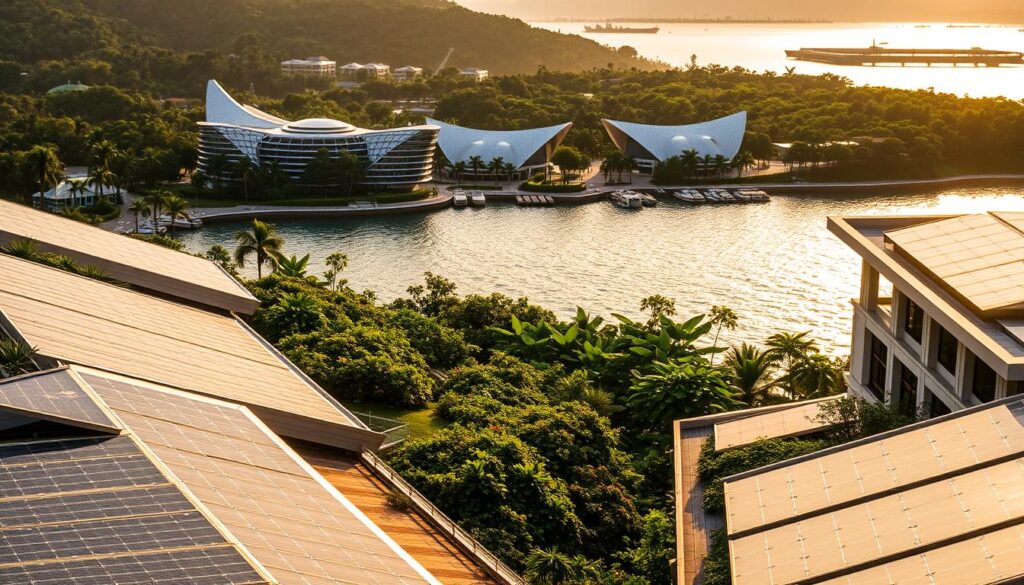
Now, let’s talk about workforces. The Venetian Macao has 28,000 employees – it’s more than a resort, it’s a community. But it’s not just about numbers. Singapore focuses on career architecture for real growth.
They see their staff as more than just workers. They’re the key to success. Upgrading skills and career paths are not just HR talk; they’re winning strategies.
There’s a big difference in how places view social responsibility. Macao is making strides, but Singapore’s IRs are leading the way. It’s the difference between doing good out of duty versus making it good business.
In the end, Resorts World Sentosa and others show that ESG is more than just green initiatives. It’s about building strong communities and making sustainability profitable. That’s a win worth celebrating.
Five‑Year View: pipeline and capex
Let’s look into the next five years of integrated resort development. Capital expenditure patterns show more than just numbers. They tell a story of different philosophies in the luxury gaming and entertainment world.
Las Vegas Sands spent $379 million in Q1 2025, mostly on Macao properties like The Londoner. This is not just spending—it’s investing in yesterday’s ideas. On the other hand, Singapore’s strategy is more like a chess game than a high-stakes gamble.
The real question is not who spends more, but who spends smarter. Singapore focuses on small improvements and efficiency, not big new projects. They play the long game, improving what they have instead of starting from scratch.
This difference in approach leads to interesting differences in development pipelines. Macao bets on building big, while Singapore aims to do more with less. The smart money is on markets that grow sustainably.
| Market | 2025-2030 Capex Approach | Primary Focus | Yield Strategy |
|---|---|---|---|
| Las Vegas/Macao Model | Aggressive expansion | Capacity growth | Square footage metrics |
| Singapore Model | Measured improvements | Efficiency gains | Yield per square foot |
| Future Outlook | Sustainable balance | Optimization | Smart capacity utilization |
The numbers show that those who focus on maximizing existing assets will do better. It’s about building a smarter casino, not just a bigger one.
The conversation is changing from “who’s bigger” to “who’s smarter.” The next five years will favor those who understand expansion is about more than just size. It’s about using your brain and being operationally excellent.
Future investment plans should focus on yield intelligence, not just square footage. The winning strategy is to think like Singapore—improve, enhance, and elevate, not just expand.
What LV Can Borrow from Singapore’s IR Playbook
The Strip could learn a lot from Singapore’s smart approach to integrated resorts. While Vegas focused on size, Singapore went for quality. Their results? Straight A’s in profitability.
Let’s talk about making money. Marina Bay Sands and Resorts World Sentosa didn’t just add shopping and shows. They created economic powerhouses where non-gaming revenue is the star. Their retail spaces beat Fifth Avenue’s, and their convention business outshines Vegas.
Singapore’s IRs are like well-oiled machines. Marina Bay Sands cuts electricity use by 20-30%. That’s saving money and the planet.
Their secret? Focus on quality over quantity. Singapore targets high-value visitors, not just crowds. This approach means more money from fewer visitors.
The regulatory lesson might be tough for Vegas. Smart rules don’t hurt business; they make it better. Singapore’s approach ensures growth and keeps social approval. Being a top destination doesn’t mean acting childish.
| Operational Metric | Singapore IRs | Las Vegas Average | Advantage |
|---|---|---|---|
| Energy Consumption Reduction | 20-30% | 5-10% | 3x efficiency |
| Non-Gaming Revenue Percentage | 45-55% | 25-35% | +20 points |
| Marketing ROI | 38% higher | Baseline | Precision targeting |
| Revenue per Square Foot | $1,850 | $1,200 | 54% premium |
Singapore’s strategy could change Vegas’ game. The numbers show that focusing on quality beats chasing volume. Sometimes, the best bet is to copy someone else’s winning formula.
Analyst Checklist
For those who love numbers, here’s your guide to IR analysis. It’s like a cheat sheet to find the winners among the losers.
First, don’t just look at the flashy things. The real money is in non-gaming areas like rooms and retail. These are the main attractions, not just side shows.
Second, check how well things run like a casino manager. Look at energy costs and how well staff work. This shows who’s serious and who’s not.
Third, get to know the rules of the game. That entry fee might seem bad, but it helps keep things stable. Smart players see it as a cost for top-notch service.
Fourth, check how easy it is to get there. Without good air connections, you can’t make money. No flights mean no profits.
Fifth, look at how green you are. Today, being eco-friendly is not just good for the planet. It’s also good for your business.
Sixth, check your finances and plans for spending. Too much debt or chasing old ideas is a big no-no.
Remember, the best players aren’t just in casinos. They’re in entertainment, hospitality, and retail too. Keep this checklist handy. In this game, only the smart ones win.


