
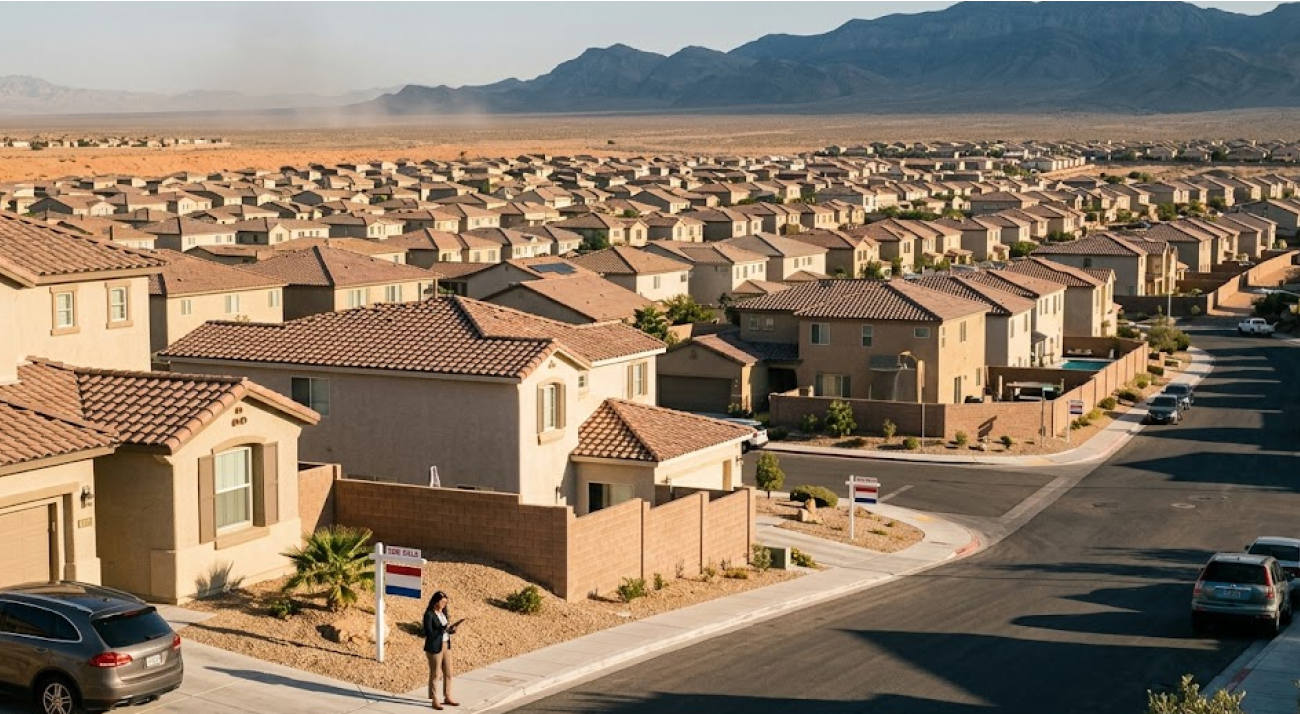
Las Vegas has reached a housing-market milestone that would have been difficult to imagine during the inventory-starved years following the pandemic. More than 10,000 homes were listed for sale across the Las Vegas Valley at the end of August, marking the first time the market has crossed that threshold in more than a decade. For readers following the broader business environment surrounding Southern Nevada, online casino reviews and industry news also provide useful context on the region’s gaming-driven economy and its connection to housing demand.
The milestone, reported by the Las Vegas Review-Journal on October 5, came from August housing data compiled by David Brownell, president of Brownell Analytics. His analysis counted 10,344 homes for sale across the valley at the end of August. Las Vegas REALTORS® reported a closely comparable 10,304 single-family homes, condominiums and townhouses available through its Multiple Listing Service.
The bigger story, however, is not simply that buyers have more homes to choose from. The increase in inventory is occurring alongside weaker demand, higher mortgage rates and declining sales activity. At the same time, prices have remained surprisingly resilient — at least until the latest September figures began showing clearer signs of cooling.
That combination is creating a very different Las Vegas housing market from the one buyers encountered only a few years ago.
Las Vegas Housing Inventory Reaches a 12-Year Milestone
The last time the Las Vegas Valley had more than 10,000 homes available for sale was during the aftermath of the Great Recession. Brownell’s data indicates the market had not returned to that inventory level since 2014, while the Las Vegas REALTORS® figures provide an almost identical August count.
That historical comparison matters because Las Vegas spent much of the post-pandemic housing boom dealing with the opposite problem.

Limited supply helped keep competition elevated as population growth, migration and strong buyer demand collided with a shortage of available properties. Builders continued adding new homes, but existing-home inventory remained comparatively constrained.
The situation has now changed.
The August inventory count represented thousands of additional opportunities for prospective buyers who previously had few choices. But the increase has not been driven exclusively by a wave of new construction or sellers suddenly flooding the market.
Demand has weakened considerably.
Brownell told the Review-Journal that under-contract activity and new escrow activity had declined for five consecutive months through August. Despite that slowdown, the median single-family sales price remained at $485,000 in August, unchanged from July and August 2025.
That disconnect between supply and prices is one of the most important features of the current market.
September Brought a Clearer Sign of Price Pressure
The latest numbers show that the market did not simply stabilize after August.
According to Las Vegas REALTORS® data reported on October 6, the median sale price for a single-family home in Southern Nevada fell to $470,000 in September, down from the record $490,000 reached in June. September’s median was also 1.1% below August and exactly the same as September 2025.
That means the market has moved approximately $20,000 below its June peak.
The change is not yet evidence of a dramatic housing crash. A $20,000 decline from a $490,000 peak represents a relatively modest adjustment, and prices remain substantially higher than they were before the pandemic.
But the direction is significant.
For months, rising inventory and weaker demand had not been enough to force the median price substantially lower. September’s data indicates that the balance may finally be shifting.
Southern Nevada’s housing supply has also reached approximately five months, another sign that buyers are gaining leverage as the number of available properties rises relative to the pace of sales.
Realtor.com Shows Even More Available Homes
Another major housing-data source provides an even larger inventory figure, although its methodology and geographic coverage differ from the Las Vegas REALTORS® MLS numbers.
Realtor.com’s September 2026 market report counted 11,047 active listings in Las Vegas, representing a 6.3% year-over-year increase. Its data showed the median list price at $464,900, down 2.1% from a year earlier.
That report also found that 25% of Las Vegas listings had undergone price cuts, compared with 20.8% nationally.
The difference between the 10,000-plus listings reported through local MLS data and Realtor.com’s 11,047 active listings should not be treated as a contradiction. Housing databases can differ in geographic boundaries, property types, listing definitions and timing.
What matters is that both sets of data point in the same direction: Las Vegas has substantially more homes available than it did a year ago, while sellers are facing greater pressure to compete.
Realtor.com also reported that the typical Las Vegas home spent 58 days on the market, compared with 61 days nationally.
For buyers, that creates a fundamentally different negotiating environment from the rapid-fire market seen during the strongest periods of the pandemic housing boom.
The $60,000 Gap Between Asking and Selling Prices
One of the clearest signals that the market is becoming more competitive for sellers is the difference between what homeowners are asking and what buyers are actually paying.
Brownell’s August analysis found a roughly $60,000 gap between the median price of homes currently listed and the median price of homes actually selling.
That gap suggests that headline listing prices can obscure what is happening during negotiations.
A homeowner may list a property based on comparable sales from earlier in the year, personal expectations or the belief that Las Vegas prices will rebound quickly. Buyers, meanwhile, are increasingly evaluating properties against higher borrowing costs and a larger pool of competing listings.
The result can be longer marketing periods, price reductions and concessions before a transaction closes.
That dynamic is already becoming visible in newer market data.
Mortgage Rates Are Making Buyers More Cautious
Higher borrowing costs are an important part of the inventory story.
On October 1, average long-term mortgage rates reached 7.28%, according to reporting from the Las Vegas Review-Journal. That represented the largest weekly increase in four years and pushed financing costs significantly higher for prospective homeowners.
For Las Vegas buyers, the impact is substantial.
A household considering a $500,000 property today must evaluate the monthly payment at a mortgage rate far above the ultra-low rates available during the pandemic. Even if the home price itself remains relatively stable, financing costs can materially change what buyers can afford.
That creates a feedback loop.
Higher mortgage rates reduce purchasing power. Reduced purchasing power limits the number of buyers able to compete for homes. Lower buyer demand causes properties to remain on the market longer. Sellers then face increasing pressure to cut prices or provide concessions.
The process does not necessarily produce a sudden collapse in home values. Instead, it can create a prolonged period in which prices gradually adjust while inventory builds.
Why Sellers Have Not Cut Prices Faster
One of the unusual aspects of the Las Vegas market is that inventory has risen considerably without producing an immediate collapse in asking prices.
Part of the explanation is that homeowners are not necessarily forced to sell.
Many existing owners refinanced when mortgage rates were dramatically lower. Selling today and purchasing another property at a substantially higher interest rate could eliminate much of the financial benefit of moving.
That can discourage homeowners from listing their properties unless they have a compelling reason to relocate.
At the same time, sellers who do enter the market may initially price their homes based on recent comparable sales rather than the increasingly competitive conditions facing buyers.
The result is a market where inventory can increase without every seller immediately accepting a lower price.
Eventually, however, properties that fail to attract offers face a decision: reduce the price, offer concessions or wait.
The growing share of price reductions suggests more sellers are reaching that point.
Buyers Have More Leverage Than They Did Before
For prospective buyers, the most important change may be negotiating power.
Realtor.com’s September data showed that one-quarter of Las Vegas listings had experienced a price reduction. That is significantly higher than the national rate reported in the same dataset.
More inventory also gives buyers the ability to compare properties rather than competing for whichever home happens to be available.
That changes the psychology of the transaction.
A buyer who dislikes the price, condition or location of one property can move on to another listing. Sellers therefore have a stronger incentive to make their homes competitive from the beginning.
For buyers with strong financing or cash, that can create opportunities to negotiate on price, closing costs, repairs and other concessions.
It does not mean every Las Vegas home is suddenly a bargain. Desirable properties in established neighborhoods can still attract strong interest, particularly when they are correctly priced.
But the market no longer gives sellers the same automatic advantage.
The Market Is Cooling, Not Collapsing
The distinction between a cooling housing market and a housing crash is important.
Las Vegas has experienced periods of extreme volatility before. During the Great Recession, prices and construction activity suffered major declines as the national housing crisis collided with the valley’s heavy exposure to real estate and construction.
The current situation is different.
Inventory is rising, sales activity is slowing and prices have moved lower from their June peak. Yet the market still has substantial economic demand behind it, and the latest price figures do not indicate the kind of rapid decline associated with a systemic housing collapse.
Instead, Las Vegas appears to be entering a period of market normalization.
The extraordinary conditions that favored sellers are fading. Buyers have more choices. Sellers have to compete harder. Mortgage rates are limiting purchasing power. And prices are beginning to reflect the weaker demand.
That transition can be uncomfortable for homeowners who purchased near the market’s recent highs, but it may eventually create a healthier relationship between prices, inventory and buyer demand.
What 10,000 Listings Mean for Las Vegas
The 10,000-listing milestone is therefore less about a single inventory number and more about a change in the balance of the Las Vegas housing market.
At the end of August, the valley had more than 10,300 homes listed for sale, according to both Brownell Analytics and Las Vegas REALTORS® data.
By September, newer market indicators were showing additional signs of weakness, including a median single-family sale price of $470,000, five months of housing supply and more evidence that buyers were gaining leverage.
Meanwhile, Realtor.com’s September figures showed 11,047 active listings, a 2.1% annual decline in median list prices, and price reductions on one in four homes.
Taken together, the numbers point toward a Las Vegas housing market that is becoming more balanced after years of unusually tight supply.
For buyers, that means more selection and greater negotiating power. For sellers, it means pricing strategy is becoming much more important. For developers and investors, the changing relationship between inventory, financing costs and demand could influence decisions about new construction and future projects.
The next phase of the Las Vegas housing market may therefore be defined less by how quickly prices rise and more by how effectively the valley absorbs its growing supply.
After years of buyers chasing limited inventory, the market is finally giving them something different: choices.
AIOSEO Metadata
Meta Title:
Las Vegas Housing Inventory Tops 10,000 Listings
Meta Description:
Las Vegas housing inventory has topped 10,000 listings as prices cool, mortgage rates rise and buyers gain more negotiating power across Southern Nevada.
Focus Keywords:
Las Vegas housing inventory
Las Vegas real estate market
Las Vegas home listings
Southern Nevada housing market
Slug:
las-vegas-housing-inventory-10000-listings