Welcome! We’re starting an exciting journey into modern casino hospitality. Imagine making a guest’s stay unforgettable with timely, thoughtful touches. That’s what we’re diving into.
Every trip has key moments that make it special. We call these “Moments That Matter.” They’re the times when a small gesture can create a lasting memory.
For Las Vegas Strip properties, this is both a challenge and a big chance. The old approach was broad, scheduled marketing campaigns. Now, it’s about having a real-time, real-time chat with each guest.
It’s like moving from a one-way conversation to a two-way, personal dialogue. It’s about being there in the moment, wherever your guest is. Are you ready to learn more? Let’s get started!
Data Pipeline Design (stream ingestion, ID stitching)
Your ability to personalize a guest’s experience in the moment depends on your data pipeline. It’s about ingesting and stitching information together in real time. Think of it as building the digital nervous system for your entire property.
Without this foundation, you’re trying to have a conversation with someone who only hears every third word. Let’s unpack how a modern pipeline works!
Traditional systems often rely on batch updates—like checking a voicemail box hours after a call. For on-trip personalization, that’s too slow. Instead, we use event streaming. Imagine a constant, flowing river of guest actions.
Every slot machine win, restaurant reservation, or lobby entry becomes a live data point flowing into your system. This event streaming approach means you’re working with a live broadcast, not a recorded message.
All these streaming events need a central place to be understood and acted upon. This is where a Customer Data Platform, or CDP, comes in. It acts as the unifying brain of your operation.
The CDP listens to the river of event streaming data. But its most critical job is identity resolution (often called ID stitching). This is the magic that connects the dots.
A single guest might interact with your property as three separate “fragments”: their player’s card at the slots, their mobile app for dinner reservations, and the hotel Wi-Fi login. Without identity resolution, you see three anonymous strangers.
ID stitching uses confident identifiers (like an email, phone number, or loyalty ID) to link these fragments into one coherent profile. Here’s what that connects:
- The gaming play from their player’s card
- The dining booking from their app
- The location data from their Wi-Fi connection
The result? You see one person moving through your resort. You know they just won a jackpot, are headed to a steakhouse, and are staying in Tower 2. This unified view is the raw material for real-time personalization.
Building this pipeline with robust event streaming and a powerful CDP is your first technical step. It turns fragmented noise into a clear signal. Now you’re ready to listen and respond to your guests while they’re on property!
Trigger Library (arrival, first wallet load, game streaks, F&B thresholds)
Imagine having a secret playbook for the best times to engage guests. That’s what a trigger library is. It’s a collection of real-time guest behaviors that signal the perfect moment for a personalized offer.
Forget guessing based on demographics. We focus on actions. When a guest does something specific, your system can respond instantly. This turns data into delightful experiences.
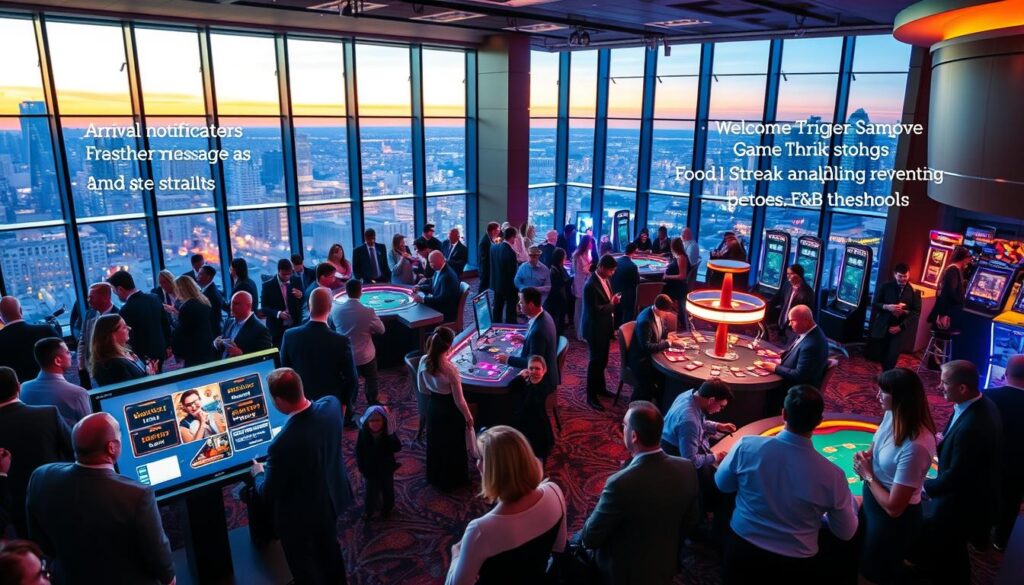
Let’s build your library with four powerful examples. Each one represents a “magic moment” where a guest is most receptive.
The Digital Welcome Mat (Arrival Trigger)
The moment a guest checks into their hotel room or enters the property is golden. They’re excited, unpacked, and deciding what to do next. A timely welcome message with a free drink credit or a slot tournament invitation sets the tone for their entire trip.
First Wallet Load (Intent Trigger)
When a guest adds money to their mobile wallet for the first time, they’re ready to play. This is a clear signal of intent. Recognizing this moment with a matched bonus or a personalized game suggestion can significantly boost their initial engagement.
Gaming Streak (Momentum Trigger)
A player hitting a streak of spins or hands is in a state of flow. Their excitement is high. Capitalizing on this momentum with a congratulatory message and a small, instant reward (like extra points) can deepen their connection to the game and the venue.
F&B Threshold (Upsell Trigger)
If a guest’s restaurant bill is approaching $50, that’s a prime opportunity. A timely offer for a complimentary dessert or a discount on a bottle of wine feels like superb service, not spam. It’s a classic upsell moment driven by behavior, not a random coupon blast.
Why are these triggers so effective? It all comes down to offer timing. A calendar-based email sent every Tuesday is generic. An offer based on a real-time action is contextually relevant. It feels like the property is paying attention and rewarding the guest’s specific behavior.
This precision is similar to managing a dynamic seat supply model in a restaurant. You adjust offers based on real-time demand, not a fixed schedule. The right offer timing based on in-venue triggers feels personal, not promotional.
Building this library is your first step from passive data collection to active, intelligent hospitality. You’re not just watching guest behavior; you’re starting a conversation at the perfect time.
Channel Orchestration (app, SMS, signage, host tools)
Deciding how to reach your guests can make a big difference. It’s all about choosing the right way to communicate. This is called channel orchestration.
Imagine a conductor leading an orchestra. Each instrument has its own special sound. You need to pick the right one for the right moment.
Why is this important? A quiet message from a host feels different from a big screen deal. Both can be powerful. You just need to match the medium to the moment.
Let’s look at your main tools for talking to guests.
Geofencing is your long-range greeting tool. It uses GPS to create a virtual boundary. When a guest’s phone enters this area, you can trigger a welcome.
Imagine a guest landing at the airport. Your system senses their arrival. A warm push notification pops up on their phone: “Welcome! Your first drink at the Azure Bar is on us.” This sets the tone instantly.
Beacons work for hyper-local magic. These are small Bluetooth devices you place in specific spots. They talk to nearby smartphones.
Place a beacon near a new slot machine bank. As guests wander close, their app can show a message. “Try the new ‘Dragon’s Fortune’ slots here! Get 50 bonus credits.” It’s marketing that feels like a helpful whisper.
For time-sensitive nudges, push notifications and SMS are champions. A guest has been playing for an hour. Send a push with a food voucher. Or, if they’re nearing a spending threshold, a quick SMS can offer a bonus.
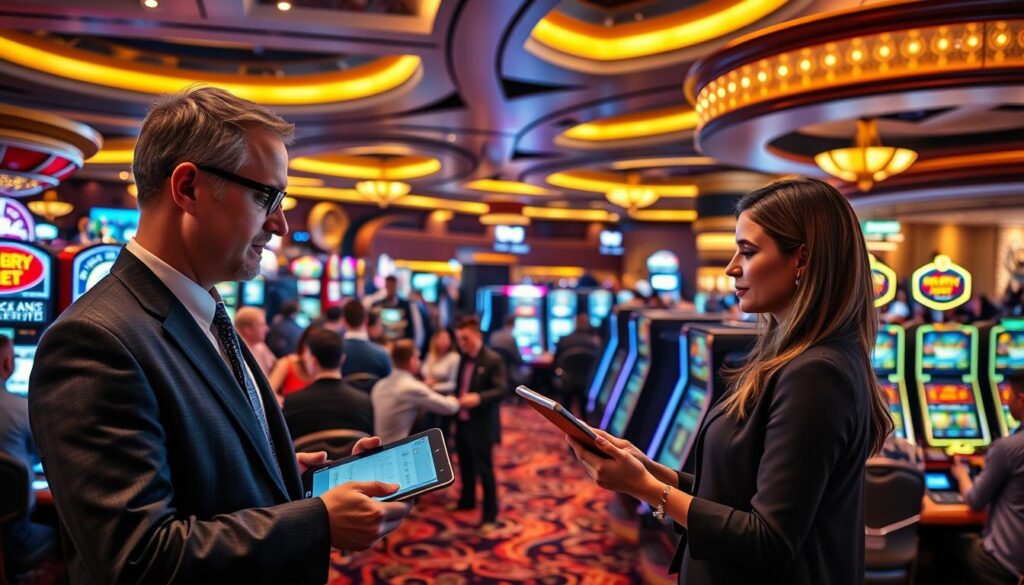
Never forget your live team. Equip hosts with tablet tools. These dashboards show real-time guest data.
A host can see a guest just hit a small jackpot. They can walk over and personally congratulate them. This human touch, powered by data, creates unbeatable loyalty.
| Communication Channel | Primary Context | Key Technology | Sample Trigger |
|---|---|---|---|
| Mobile App Push | Engaging guests who are actively using their phone on property. | Mobile SDK, Event Triggers | Guest achieves a 5-game streak in the sports book. |
| SMS/Text Message | Time-critical offers or guests who may not have the app open. | SMS Gateway, Phone Number | Guest’s food & beverage spend passes $100. |
| Digital Signage | Broadcasting offers to crowds in specific zones (e.g., lobby, bar). | Beacons, Content Management System | A large group enters the high-limit area. |
| Host Tablet Tool | Enabling personalized, face-to-face interactions by staff. | Real-Time Dashboard, Guest Profile | Host views a guest’s current trip wallet balance and play. |
The goal is a unified experience. A guest might see a sign, get a push, and then be greeted by name. All channels work together.
Start by mapping guest journeys. Find the key moments. Then, assign the channel that feels most natural and effective for each one. Your communication will suddenly feel seamless and smart.
Experimentation and Incrementality Measurement
How can you be sure your personalized offers are actually driving extra revenue? The answer lies in incrementality measurement. This isn’t about counting total sales after a campaign. It’s about isolating the extra value your real-time system created that wouldn’t have happened without it.
Think of it like a clinical trial for your marketing. To know if a new medicine works, you give it to one group (Group A) and a placebo to another (Group B). Only then can you see the true effect. We apply the same scientific rigor.
For instance, when a guest hits a jackpot, your trigger library might send a celebratory spa offer. If they book, is that revenue because of your offer, or would they have booked it without it? Without a control group, you’ll never know. This is the core challenge of attribution in a dynamic trip.
Measuring true incrementality solves this. You randomly split similar guests into two groups:
- Group A (Test): Receives the real-time trigger (e.g., the spa offer after the win).
- Group B (Control): Does not receive the trigger.
By comparing the behavior and spend of these two groups, you can calculate the “lift”. This lift—the extra spa bookings, longer playtime, or higher restaurant bills from Group A—is your proven, incremental ROI. It’s revenue you can confidently credit to your personalization engine.
Frameworks for this involve setting up these A/B tests for key triggers. You don’t test everything at once. Start with your highest-value moments, like first wallet loads or big wins. The data pipeline you built feeds this, ensuring groups are matched fairly.
This approach moves you from guessing to knowing. It transforms your program from a cost center into a proven profit driver. You get a clear report card showing exactly which triggers create real value and which are just noise.
Embracing this scientist mindset is how you build a case for more investment. You’re not just sharing engagement metrics; you’re presenting hard evidence of causal impact. That’s the ultimate key to scaling personalization with confidence.
Privacy and Frequency Caps
Privacy and message frequency are key to guest trust in your brand. Your real-time marketing system is like a powerful engine. It needs both an accelerator and reliable brakes to be safe and effective.
Building privacy into your system changes everything. It means thinking about data protection from the start, not adding it later. This approach builds a foundation of trust that guests can feel throughout their trip.
Being transparent is your first tool. Guests should understand what data you collect and how it improves their experience. Use clear, simple language in your consent prompts. Explain the value exchange, like how their location helps you send timely dining offers.
Next, consider anonymization strategies. You can get valuable insights without always linking every action to a specific person’s name. For example, analyzing aggregate movement patterns can inform signage content without tracking individual guests.
Now, let’s talk about the other key brake: frequency caps. These rules prevent your system from sending too many messages. Without them, even relevant offers become noise. The goal is to be respectfully relevant, not intrusively everywhere.
Effective frequency caps work across channels. You might set rules like:
- No more than two app notifications in a 24-hour period.
- A maximum of one SMS per day, only for high-priority triggers.
- Respecting “quiet hours” during late-night and early morning.
These caps ensure you enhance the trip without becoming a nuisance. They force your team to prioritize the most impactful moments. Is it the first wallet load, or a third consecutive game? By limiting messages, you make each one count more.
Combining strong privacy practices with smart frequency rules creates a win-win. Guests feel in control and respected. Your marketing feels helpful, not creepy. This balance is what transforms a clever technical system into a genuinely welcomed part of the guest journey.
Remember, these guardrails aren’t restrictions—they’re the framework that makes your personalization powerful and sustainable. They protect your guests’ experience and your brand’s reputation, ensuring every real-time interaction strengthens the relationship.
Revenue Impact: Trip Value, return rate, and cross‑sell
Real-time personalization is more than just cool tech. It’s a key to making more money. Every message and offer is made to boost important business numbers. Let’s look at how this adds up to more money.
The first big win is on trip value. This is how much a guest spends during their stay. Imagine a guest who just won big. A timely offer for champagne at the steakhouse feels like a reward, not an ad.
This in-the-moment prompting turns browsing into buying. It changes a “maybe later” into a “yes, right now.” By suggesting extras at the right time, you increase the average spend per visit.
Next, we boost the return rate. Profit comes from more than one visit; it’s about a guest’s lifetime value. When a guest feels understood—like getting a free dessert on their birthday or a slot bonus—they make a positive connection.
This connection builds loyalty. A guest who feels valued, not just a wallet, is more likely to return. Increasing your return rate means more future revenue with less marketing cost.
The third key is successful cross-sell. The goal is to get guests to spend more than just at the casino. A player on a winning streak might get show tickets. A guest who just spent hours at the slots might get a spa discount.
This strategic cross-sell spreads revenue across your whole property. It turns a casino visit into a full-resort experience, maximizing revenue from every guest.
So, how do you measure this financial uplift? Start by tracking the extra revenue from each campaign. Compare the spend of guests who got a personalized offer to those who didn’t.
You’ll often see a direct increase in trip value from spend-promoting triggers. Track how often guests who got personalized offers come back. Also, look at how many guests use offers in restaurants, retail, or shows to measure cross-sell success.
When you add these increases together—more spend per trip, more trips, and spending in more places—you see the real profit. Personalized moments stop being a cost and start driving real, scalable revenue.
Staffing and Host Enablement
Success in real-time guest engagement depends on two key things: strong technology and a skilled team. The best tech won’t work if your staff isn’t ready to use it. We help connect the digital system with the human touch.
You might need to create new roles to manage this system. Think of them as the leaders of your personalization team.
Two important roles often come up: the Real-Time Campaign Manager and the Data Orchestration Analyst. The manager plans the campaigns based on guest actions. The analyst makes sure the data flows right to make those campaigns work.
| Potential New Role | Core Responsibilities | Key Skills Needed | Impact on Guest Journey |
|---|---|---|---|
| Real-Time Campaign Manager | Designs and A/B tests trigger-based campaigns; defines business rules for offers; analyzes performance metrics. | Marketing strategy, data literacy, creative problem-solving. | Ensures the right message hits the guest at the perfect moment to enhance their trip. |
| Data Orchestration Analyst | Monitors data pipeline health; stitches guest IDs across systems; ensures trigger logic executes without errors. | Technical analytics, SQL, understanding of event-streaming platforms. | Guarantees the system’s reliability so personalization feels seamless, not buggy. |
| Guest Experience Liaison | Translates data insights into actionable playbooks for hosts; serves as the bridge between tech teams and frontline staff. | Communication, hospitality expertise, training ability. |
We also need to empower your frontline teams. Your hosts and concierges are the main attraction! They need the right training and tools to keep the personalized conversation going.
Imagine a host greeting a guest who just won a game. Instead of a generic welcome, the host’s tablet shows the guest’s win, their favorite drink, and a congratulatory offer. The host feels prepared and confident.
Good training programs do more than teach button-clicking. They teach staff to understand trigger alerts and use that info to offer real, memorable service. Role-playing different scenarios helps build confidence.
This approach creates a beautiful mix. Digital nudges start the conversation, and your enabled hosts finish it with a memorable touch. This turns single interactions into a complete, personalized journey that guests love and want to experience again.
Risk Controls and Fail‑safes
Think of your real-time personalization system as a high-performance car. It’s fast and powerful. But, it needs brakes, airbags, and a dashboard for warnings. Risk controls and fail-safes are like these safety features for your system.
Before you go live, these “safety nets” are essential. They protect your guests and your casino’s reputation. They’re there to catch any unexpected issues.
Guest trust is your most valuable asset. A delayed “Congratulations on your big win!” message can feel awkward. A bug in a trigger rule could spam a guest with too many offers. These mistakes can ruin the magic of real-time relevance.
Our goal is to keep your system stable and maintain guest trust. Even when things don’t go as planned, we aim to keep everything running smoothly.
Let’s look at the three core safety features you need: a vigilant monitoring system, automatic circuit breakers, and clear manual override protocols. Together, they form a strong defense.
First, you need to watch everything closely. Monitoring alerts are like your system’s warning lights. They keep an eye on data latency, message send rates, and error codes.
If the data feed slows down, an alert will notify your team before guests notice. If a trigger fires too many times, that’s a red flag! Setting thresholds for these alerts helps you catch problems early.
Next, we have automatic circuit breakers. These are your system’s reflexes. They automatically shut down a process that’s behaving badly.
For example, if a “first wallet load” offer starts sending to every guest every five minutes, a circuit breaker can trip. It halts that specific trigger or channel instantly. This prevents a small bug from becoming a major incident.
Lastly, you must have a manual override protocol. No system is perfect, and sometimes human judgment is needed. Your hosts and marketing managers need a clear, simple “big red button” to pause all campaigns or stop messages to a specific guest.
This is vital for handling sensitive situations or if a broader system issue is detected. The protocol must define who has the authority, how they are notified, and the steps to safely resume operations.
Here’s a quick comparison of these essential fail-safes and when to use them:
| Fail-Safe Type | Primary Purpose | Real-World Example | Activation Speed |
|---|---|---|---|
| Monitoring Alerts | Early detection of anomalies and performance dips. | Alert when data ingestion latency exceeds 30 seconds. | Near real-time notification. |
| Circuit Breakers | Automatically halt faulty processes to contain damage. | Stop all SMS sends if error rate exceeds 5% in 2 minutes. | Instantaneous (auto) |
| Manual Override | Human intervention for complex or unforeseen issues. | Host pauses all offers for a guest who has reported a problem. | Minutes (human-driven) |
Implementing these controls might feel like adding complexity. But they actually give you more confidence to be aggressive with personalization. You know there’s a safety net.
Start by defining your “what-if” nightmares. What if the geofence trigger fails? What if a game streak rule double-counts? Then, design your alerts, breakers, and overrides to address those specific scenarios.
Remember, the goal isn’t to build a system that never fails. That’s impossible. The goal is to build a real-time system that fails gracefully and recovers quickly. By putting these risk controls in place, you protect the guest experience, empower your team, and ensure your powerful personalization engine drives value safely for the long haul. Now you’re ready to go live with peace of mind!
12‑Month Build Roadmap
Turning guest personalization into a reality takes time. Here’s a step-by-step plan for the next year. It breaks down the journey into easy-to-manage parts. Each quarter brings new value, building momentum and proving your concept.
Building a house is like this. You start with the foundation, not the furniture. This structured approach makes sure your system is strong before adding the fancy stuff that impresses guests.
Let’s look at each quarter, from starting to adding advanced features.
Quarter 1: Laying the Foundation
The first three months are all about getting ready. This phase is key for success. You’ll pick the right Customer Data Platform (CDP) as your main brain. Then, you’ll build the initial data pipeline to connect guest IDs from different places.
You’ll define your core data schema and set up privacy rules. By Q1’s end, you’ll have a unified guest profile ready for action. This work is behind the scenes but powers everything that comes next.
Quarter 2: Your First Pilot Campaign
Now, it’s time for the fun part—launching your first real-time triggers! In Q2, you’ll test a simple but powerful campaign on one channel, like your mobile app. A good start is a “Welcome & First Wallet Load” trigger.
When a guest first loads their digital wallet, your system sends a personalized offer. This focused pilot lets you test the tech, see how guests react, and show a quick win. You’re proving the value of real-time engagement in a controlled way.
Quarter 3: Multi-Channel Expansion
With a successful pilot, Q3 is about reaching more guests. You’ll add new channels to your system. This is where you achieve true multi-channel orchestration.
Imagine a guest on a gaming streak. Your system can now send a congratulatory message to digital signage, offer a drink via SMS, and alert a host to deliver a reward. You’re creating a seamless, magical experience.
Quarter 4: Scaling and Optimizing
The last quarter is about growing your success across the whole resort and introducing advanced optimization. You’ll move from targeted campaigns to resort-wide optimization, using what you’ve learned for all guests.
This phase often includes using AI to predict the next best action for each guest in real-time. You’ll also start a culture of continuous testing, always trying new triggers and offers to increase trip value and loyalty.
Here’s a quick-view summary of your year-long journey:
| Quarter | Phase | Key Activities | Outcome |
|---|---|---|---|
| Q1 | Foundation | CDP selection, data pipeline build, ID stitching, privacy setup. | Unified, actionable guest profiles ready for triggers. |
| Q2 | Pilot | Launch first trigger (e.g., arrival/wallet load) on a single channel (app). | Proof of value, measured guest engagement, team confidence. |
| Q3 | Expansion | Add SMS, signage, and host tools to orchestration; run multi-channel campaigns. | Seamless, cross-channel guest experiences that drive revenue. |
| Q4 | Scale & Optimize | Resort-wide trigger deployment, advanced AI modeling, establish test-and-learn culture. | Maximized lifetime guest value and a fully operational personalization engine. |
Remember, this 12-month build roadmap is designed to build confidence and show return at every step. You don’t need to do everything at once. Start with a solid foundation, celebrate your Q2 pilot win, and let that success fuel your growth. Before you know it, you’ll be delivering unforgettable “moments that matter” to every guest, in real-time.
KPIs and Executive Dashboard
Measuring your personalization program’s success is key. Don’t just look at vague “engagement” metrics. Your KPIs should show real business drivers.
Keep an eye on trigger conversion rates and incremental revenue. Look for less message fatigue and higher guest satisfaction scores. These KPIs show if your efforts are paying off.
An executive dashboard makes this data easy to see. It’s like a single window for leaders. It shows how personalization affects guests and the company’s finances.
With the right dashboard, you get clear insights. You see which triggers add value and spot trends fast. This helps your team make quick, smart choices. It proves your program’s worth and guides future improvements!